
Making the Work Visible: Photographing Polaris in Action
When an organization needs new photography, one of the first questions is usually what needs to be photographed.
Headshots. People working. Facilities. Equipment. Maybe a few photographs for the homepage.
Those are important questions. But I think there's a bigger one worth asking first:
What does someone need to understand about your organization after seeing the photographs?
That question became especially important during a recent project with Polaris, a Rhode Island nonprofit that works with manufacturers, technology companies, workforce partners, and other organizations throughout southeastern New England.
Polaris was preparing an updated website and wanted to build a new library of photography to support it. The organization works across manufacturing and technology, including Polaris MEP, which provides consulting, technical support, and workforce development for manufacturers throughout Rhode Island. The project ultimately took place over three half-days at multiple locations. We created new headshots of Polaris associates, photographed their team interacting with clients, and documented manufacturing environments where their work actually takes place.
The headshots showed the people behind Polaris.
The manufacturing photography needed to show something more difficult.
It needed to show what they do.
Showing the Work, Not Just the People
Through Polaris MEP, the organization provides consulting and technical support designed to help manufacturers improve performance, reduce costs, develop their workforce, and grow.
You can write that on a website.
Showing it in a photograph is different.
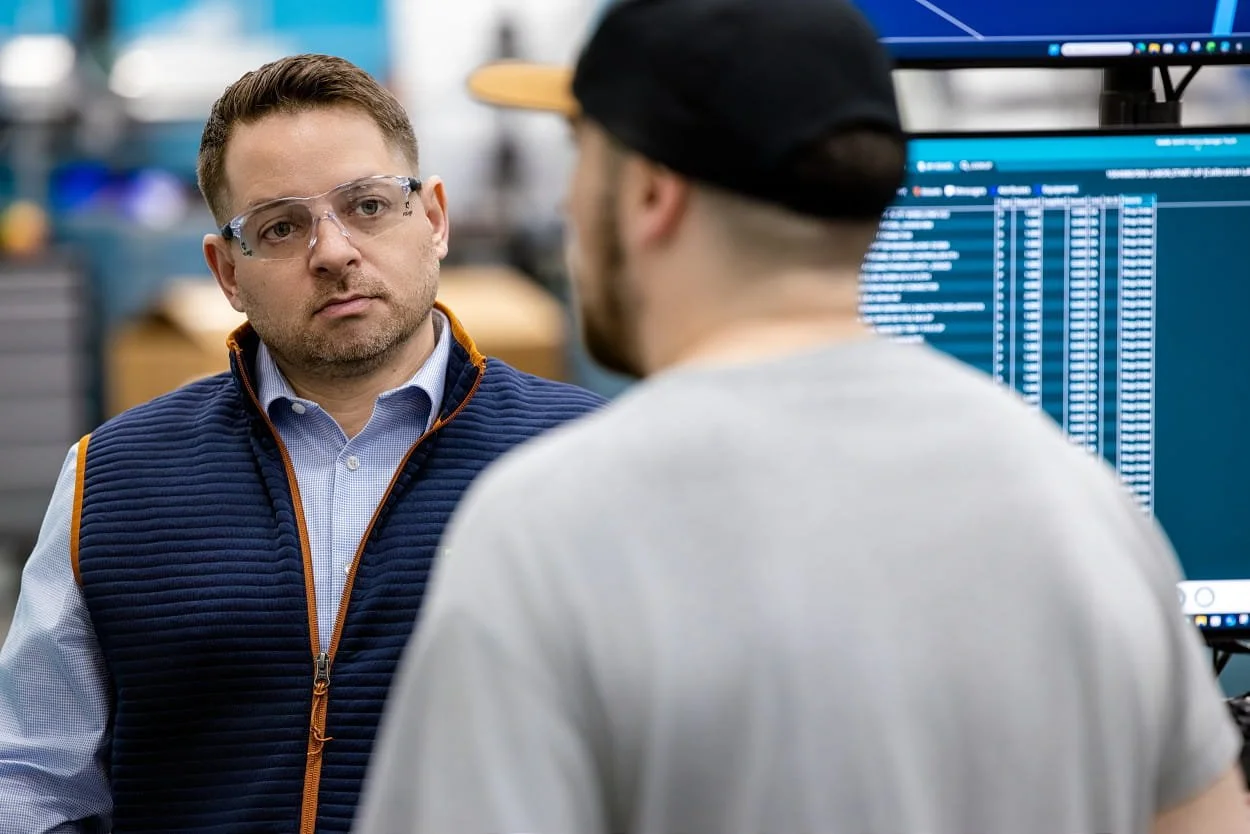
For one half-day of the project, we joined members of the Polaris team at Hexagon Manufacturing Intelligence in North Kingstown, Rhode Island. This part of the project gave us an opportunity to photograph the manufacturing side of Polaris's work in a real client environment rather than trying to recreate it in an office. The goal was to photograph Polaris associates interacting with Hexagon associates while learning about equipment, processes, safety protocols, and how work moves through the facility.
We knew the kinds of photographs we wanted before arriving. What we didn't know was exactly how those photographs would unfold.
I hadn't personally scouted the location. Polaris MEP had visited about a week earlier while I was traveling. So when my assistant and I arrived with our equipment, I was seeing the production environment for the first time.
That's where experience becomes important.
Working Within a Manufacturing Environment
I've photographed inside manufacturing and industrial facilities hundreds of times over the years, and every facility is different.
Hexagon immediately stood out for how clean, modern, busy, and high-tech the environment felt. There were interesting photographs almost everywhere I looked.
But having interesting things to photograph doesn't mean you can simply point a camera wherever you want.
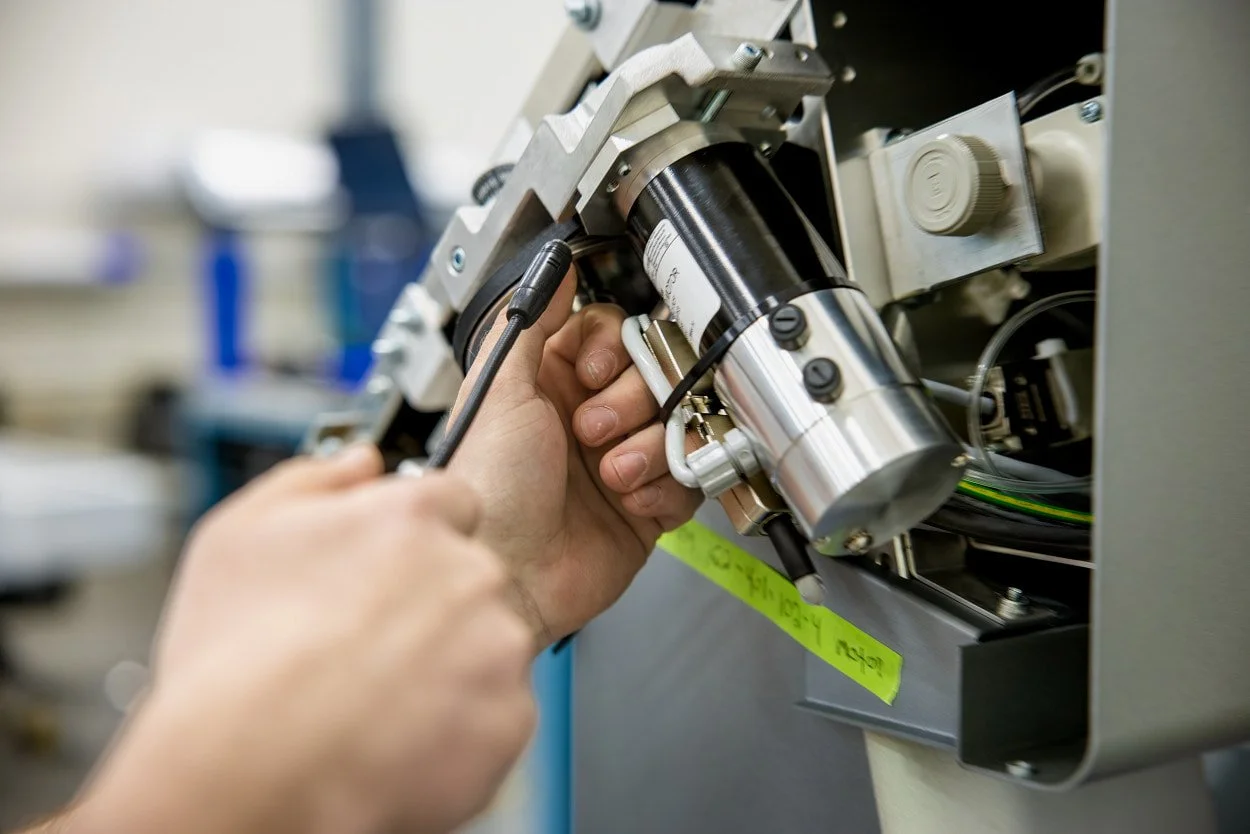
Proprietary equipment and processes are always a consideration in manufacturing photography. We needed to understand what could be photographed and what couldn't. Safety was equally important, both for our small crew and for the Hexagon and Polaris MEP associates we were photographing.
We also needed to remember that Hexagon was operating a manufacturing facility. They weren't there for us.
Our job was to work around them.
That influenced how I approached lighting. I could have brought in larger lights, stands, modifiers, and more equipment to control each scene. That might have created a more polished photograph, but it also would have slowed us down, put additional equipment into active work areas, potentially interfered with production, and introduced unnecessary safety concerns.
Instead, we stayed lean.
My assistant and I worked with two small handheld lights that we could move quickly from one situation to another. My assistant handled much of the lighting and equipment logistics, which allowed me to concentrate on the people, interactions, composition, and moments happening in front of me.
The goal wasn't to make the facility look like a studio.
I wanted it to feel like the environment we were actually experiencing.
Somewhere Between Photojournalism and Direction
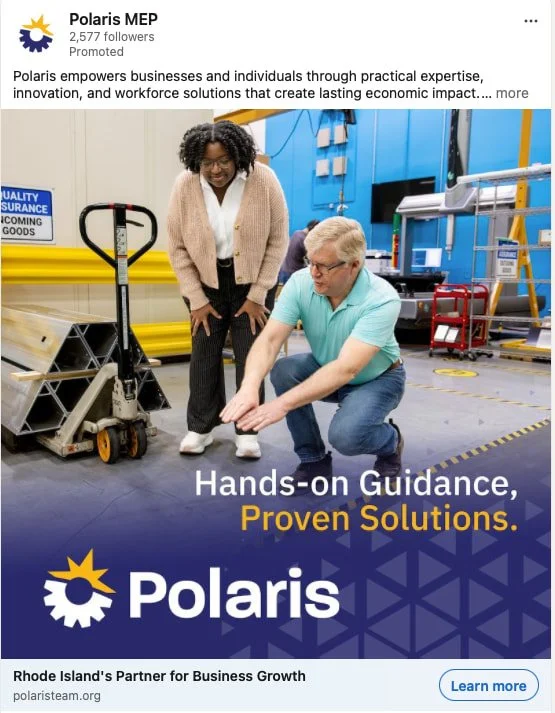
One of the photographs from the Hexagon project later became part of a Polaris advertising campaign, showing how an image created for a broader library can take on a specific purpose.
There is an assumption sometimes that authentic photography has to be completely candid.
I don't think that's necessarily true.
Much of what I photographed at Hexagon began with observation. I watched Polaris associates talk with Hexagon associates. I watched them examine equipment, discuss processes, ask questions, and learn why something was being done a particular way.
Those interactions were real.
Sometimes I simply let them happen.
Other times, I saw the beginnings of a strong photograph and provided a little direction. I might ask someone to repeat an action, move slightly, continue a conversation, or use their hands in a way that helped communicate what they were discussing.
I'm not trying to invent a moment that didn't happen. I'm trying to take something genuine and make it visually understandable.
One photograph from the project is a good example.
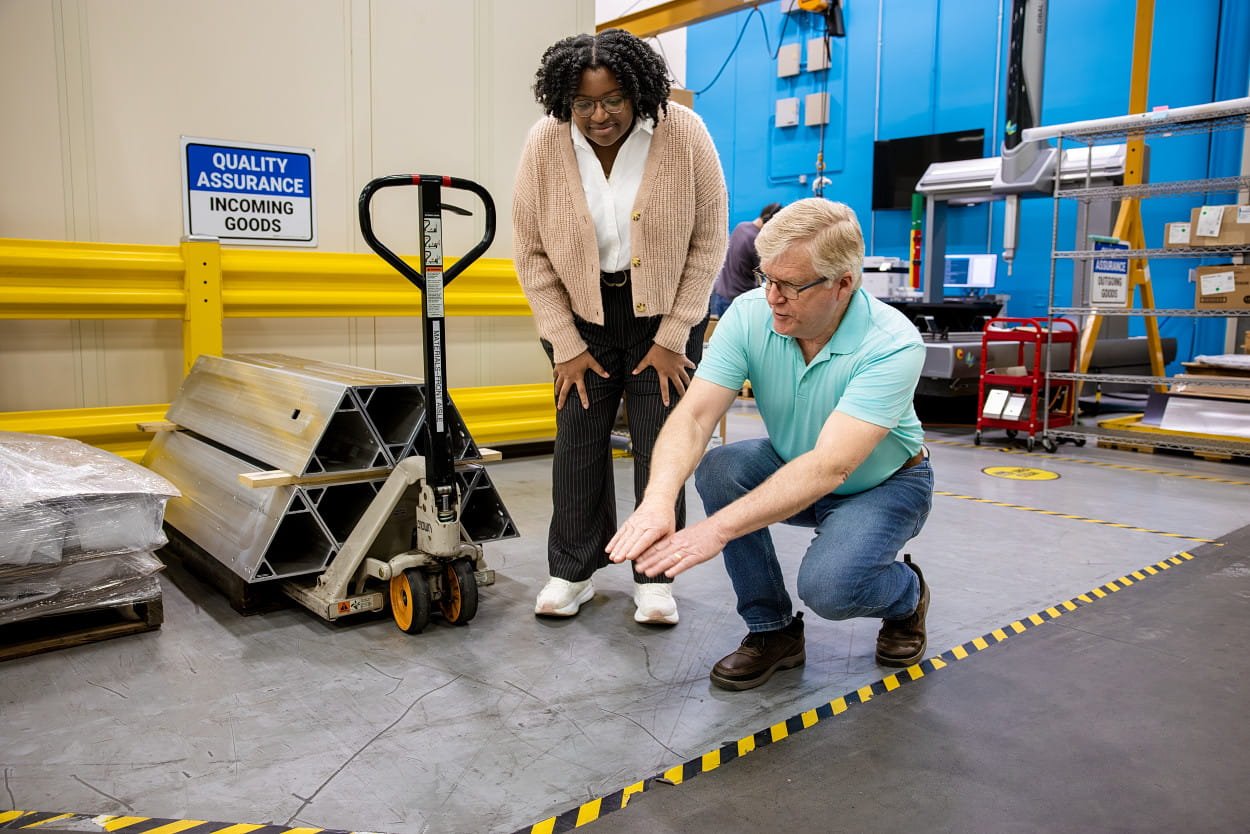
Two members of the Polaris team were discussing how Hexagon had properly applied various safety markings on the manufacturing floor. I recognized that the interaction could help communicate the hands-on nature of Polaris's work, so I asked them to continue the discussion in a way that allowed me to photograph it more clearly.
Later, Polaris used that photograph in a LinkedIn advertisement built around the message “Hands-on Guidance, Proven Solutions.”
Across the image were the words:
Hands-on Guidance, Proven Solutions.
Seeing that finished ad was particularly satisfying because I knew how and why we'd created the photograph.
It wasn't simply an interesting picture from a manufacturing facility.
It was doing its job.
Building an Image Library Instead of a Collection of Photographs
That's one reason I encourage clients to think beyond the immediate need when planning photography.
The original push for this project was Polaris's updated website. But a useful image library shouldn't only solve today's website problem.
The photographs can have a much longer life.
Over the course of the project, I delivered hundreds of finished images covering headshots, people working together, manufacturing environments, equipment, processes, and the interactions that help explain what Polaris does.
Some photographs can become website banners. Others might work on service pages, social media, presentations, advertising, reports, recruiting materials, or marketing pieces that haven't even been conceived yet.
I don't always know exactly how a client will use an image when I press the shutter.
Neither do they.
That's part of the reason variety matters.
A clean, consistent headshot introduces someone to you. An environmental photograph can establish where they work. A photograph of two people leaning over a piece of equipment can communicate collaboration, curiosity, expertise, or problem solving.
Together, those photographs tell a much more complete story than any one of them could on its own.
Photography With a Purpose
Manufacturing photography has its own challenges.
You need to understand safety. You need to respect proprietary information. You need to work around production instead of expecting production to work around you. Lighting decisions have to balance image quality with mobility and practicality. And you need to be comfortable walking into an unfamiliar environment and finding the story quickly.
But the technical challenges aren't really the point.
The point is understanding why the photographs are being created in the first place. That approach to visual narrative photography is less about creating individual images and more about building a collection that helps tell the larger story of an organization.
For Polaris, we weren't simply photographing a modern manufacturing facility. We were showing its people engaged with the manufacturers they serve. We were creating photographs that could help someone looking at their website or marketing understand that their work is collaborative and hands-on.
Months or years from now, Polaris may use some of these photographs in ways none of us anticipated during those three half-days.
That's exactly what a good image library should allow them to do.
The individual photographs matter.
What matters even more is what they make visible.