When the Room Does Not Cooperate
Professional decision-making in a live event environment
One-hour fireside chat recorded live in a restaurant event space.
Not every project happens in a studio. Some of the most important work happens in rooms you cannot control.
This project was a live, sold-out fireside chat held in the back bar of a working restaurant. It featured a host, a speaker, and an engaged audience, followed by an extended Q&A. There were no resets, no pauses, and no opportunity to stop and fix things if something went sideways.
This is not a portfolio showcase. It is a look at how I approach real-world production when conditions are fixed and expectations are high.
The reality of the space
The space dictated the approach.
The room was tight. The layout was fixed. Behind the speakers were glass doors. The event took place at night using the venue’s ambient lighting. Audience members were seated behind the camera, which meant sightlines mattered as much as framing.
When I walk into a room, I immediately start assessing light sources, windows, reflections, sound, and scale. As the setup takes shape, I am constantly refining decisions. If we do this, what problem does it solve. What problem might it create.
There was no practical way to introduce lighting without disrupting the environment or the audience experience. There was also no room for multiple camera positions without blocking views or adding unnecessary complexity.
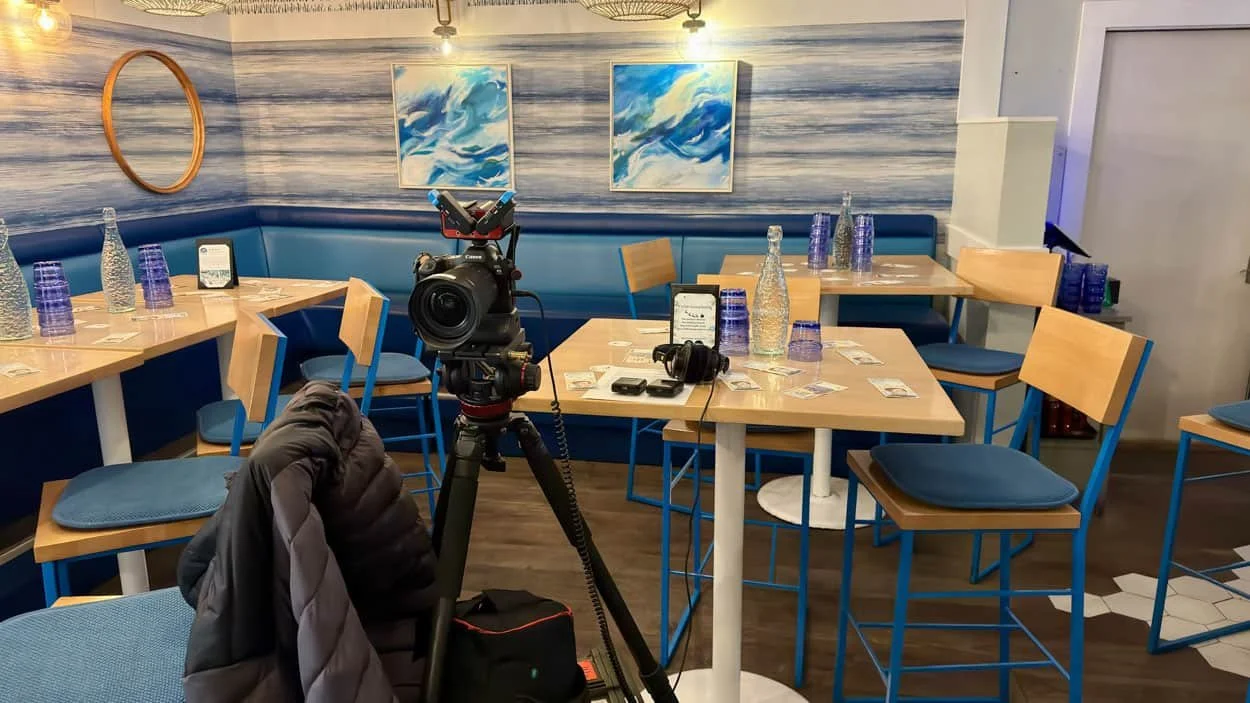
Single-camera setup in the event space before doors opened.
Priorities when perfection is not possible
When ideal conditions are not available, priorities matter.
For this project, the priorities were clear:
Capture clean, intelligible audio
Maintain stable, intentional framing for the full conversation
Avoid visual distractions that pull focus away from the speakers
Respect the flow of the event and the audience experience
Sound always comes first. I have learned that audiences will forgive visual imperfections far faster than they will forgive audio they cannot understand.
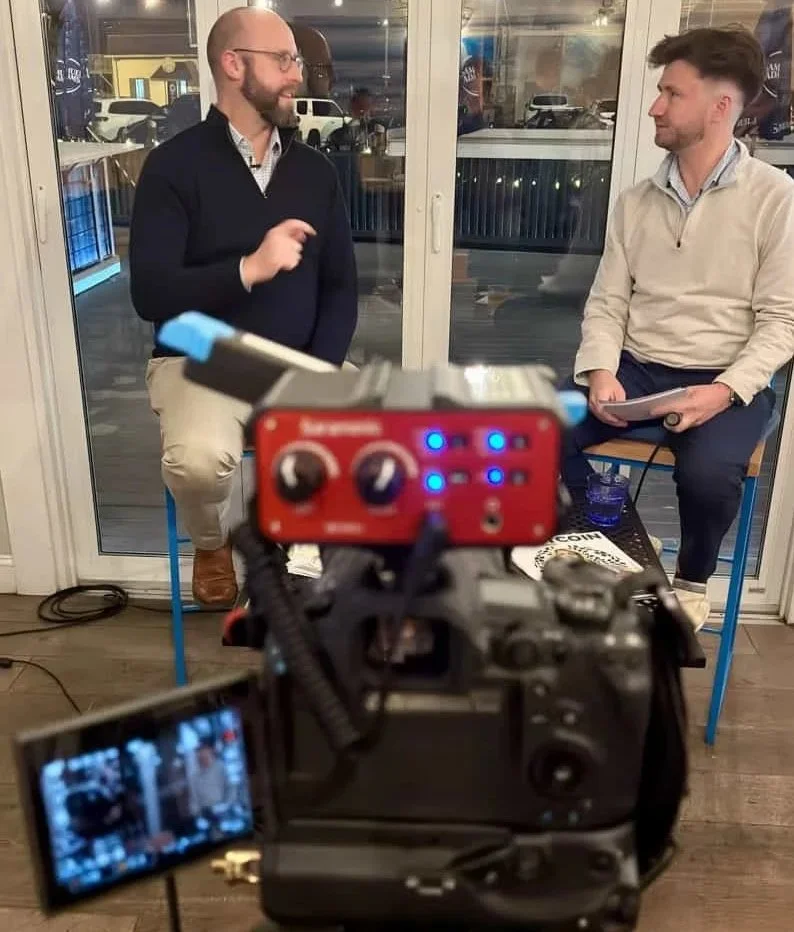
One-camera coverage during the live fireside chat.
Why one camera was the right decision
In an ideal scenario, this type of conversation would be covered with three cameras. One on each speaker and a wide shot to tie it together.
In this room, that approach would have caused more problems than it solved.
I tend to keep things simple. More equipment increases complexity, and complexity increases the chance of failure. The more gear involved, the more people are needed to monitor it. In this case, it was just me. Simplicity was not a limitation. It was a strategy.
A single camera allowed me to preserve audience sightlines, reduce points of failure, and maintain visual continuity across an hour-long conversation. It also allowed me to stay fully present and responsive throughout the event.
Audio in a live environment
Both the host and the speaker were mic’d with professional wireless microphones. The room also had a PA system and microphones available, but for recording purposes I chose to run an independent wireless setup.
That decision required testing and coordination to avoid feedback and ensure clean signal, but it allowed me to capture consistent, high-quality audio regardless of how the room behaved.
Audience questions were handled without a dedicated handheld microphone. Logistically, introducing an audience mic would have added friction to the flow of the conversation. Instead, we planned for questions to be captured through the host and guest microphones, with the understanding that questions would be repeated when possible.
In practice, that did not always happen. Even so, the questions were still captured clearly through the existing microphones, allowing the conversation to remain intact without interrupting the event.
Preparedness and contingency planning
Live events are unforgiving. Batteries drain. Cameras heat up. Wireless systems can fail.
I plan for that.
For every project like this, I monitor power, temperature, and signal stability throughout the event. I build in redundancy and have contingency plans ready so that if something fails, the audience never knows.
I invest in reliable, professional-grade equipment and always carry backups. Not to chase specs, but to reduce risk. Preparation allows me to focus on the conversation instead of the gear.
When time is fixed and the audience is watching, preparation is not theoretical.
Outcome and distribution
All of that planning serves a simple goal. Deliver usable, meaningful content without disrupting the moment.
The final deliverables included a complete one-hour fireside chat published on the client’s YouTube channel, along with short-form reels used across LinkedIn and X. The long-form video serves as a permanent record of the conversation, while the reels extend the reach of the event and support ongoing messaging for the organizations involved.
Experience shows up here
Not every project happens in ideal conditions. Many do not.
This is where experience matters most. Knowing what to prioritize. Knowing what to simplify. Knowing how to adapt without drawing attention to the constraints.
This project did exactly what it needed to do. It captured an important conversation clearly and professionally, despite a room that did not cooperate.
That is how I perform when the variables are fixed.
This mindset carries through all of my video projects, especially when working in real environments with fixed variables.